Adding Sudoku to libipuz
Status: Draft | Sep 2025
Author: Jonathan
Reviewer: Federico, Sepehr
Goals
This doc details a proposed way of implementing sudoku-style puzzles in libipuz. There are a number of such puzzles listed in the ipuz spec. We want to load, save, and potentially modify these puzzle kinds.
Prior Art: Gallery
Since I was unfamiliar with some of the variants, I put together a quick gallery with some examples I found. It gives a sense of what each variant could look like. The rules will need to be written down and documented.
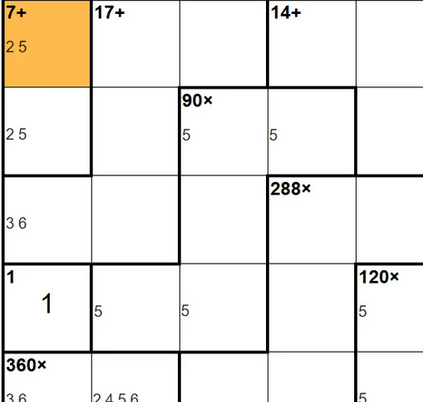
Calcudoku
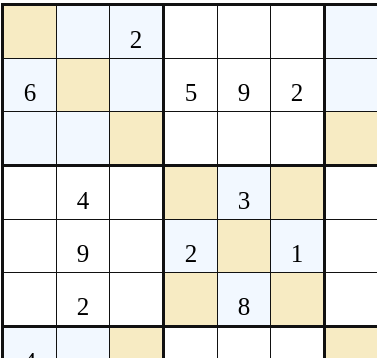
Diagonal Sudoku
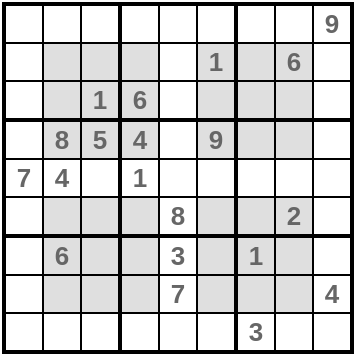
Hyper Sudoku
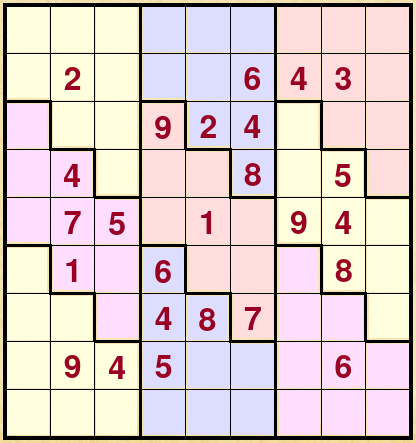
Jigsaw Sudoku
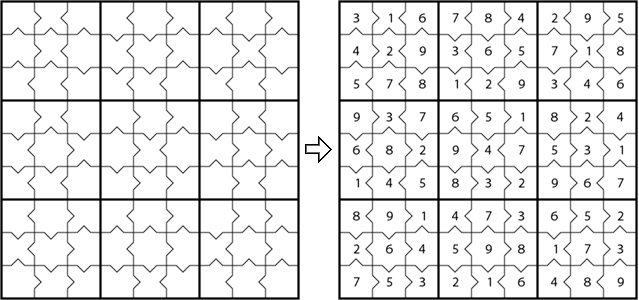
Greater Than Sudoku
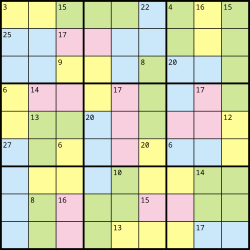
Killer Sudoku
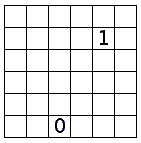
Latin Square
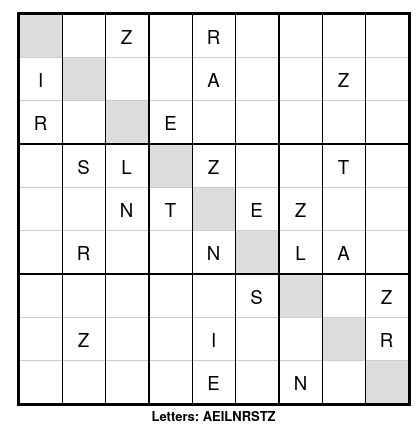
Wordoku
Overall Approach
We create a Sudoku base class that inherits from IpuzGrid. Each cell
in IpuzGrid has a a numerical value (or letter) and can be accessed
through the grid functions.
Proposed Class Heirarchy
We add the following classes to libipuz:
IpuzPuzzle
↳IpuzGrid
 ↳IpuzSudoku
  ↳IpuzCalcudoku
  ↳IpuzSudokuDiagonal
  ↳IpuzSudokuHyper
  ↳IpuzSudokuJigsaw
  ↳IpuzSudokuGreaterThan
  ↳IpuzSudokuKiller
  ↳IpuzLatinSquare
  ↳IpuzWordoku
Note
I decided on IpuzSudokuHyper instead of IpuzHyperSudoku for class
naming convention, as it’s close to what GTK does. IpuzNonogramColor
does this as well. That being said, we may want to go with
eg. IpuzKiller and drop the Sudoku string from the class
name. It’s more concise, and matches IpuzCryptic / IpuzBarred. We
are inconsistent here.
Representation
IpuzSudoku inherits from IpuzGrid. Each IpuzCell within the grid
can have either a solution or a number depending on puzzle kind,
though not both. The label and initial val attributes are
unused. In addition, cells can have an IpuzStyle attached to them.
Kind |
Cell Value Type |
::boxes |
Group Type |
|---|---|---|---|
SUDOKU |
|
|
|
CALCUDOKU |
|
|
|
DIAGONAL |
|
|
|
HYPER |
|
|
|
JIGSAW |
|
|
|
GREATER_THAN |
|
|
|
KILLER |
|
|
|
LATIN_SQUARE |
|
|
|
WORDOKU |
|
|
|
Note
GREATER_THAN uses an IpuzStyle on border cells to indicate the
equality comparisons.
API
The base class, IpuzSudoku will have the following properties,
shared across all the variants:
::values GArray<string/null> — Values used in the puzzle
::displayvalues boolean — Indicates the list of values should be displayed
::boxes boolean — Divide the puzzle into boxes
::showoperators boolean — Show calculation operators
::cageborder enum{THICK / DASHED} — Cage borders are thicker or dashed
Not every value is used with every puzzle type, but like the spec,
there’s enough overlap that we should keep all these the base
IpuzSudoku class.
Groups
In addition, the spec has the concept of Zones and Cages. These
are effectively a set of cells with a style, and in the case of cages,
a value and operator as well. No puzzle type has both. The spec
treats them as separate types, but there’s enough overlap that it’s
easier to combine them into the same struct. We will use
IpuzCellGroup for this:
typedef enum
{
  IPUZ_CELL_OPERATOR_NONE = 0,
  IPUZ_CELL_OPERATOR_PLUS,
  IPUZ_CELL_OPERATOR_MINUS,
  IPUZ_CELL_OPERATOR_MULTIPLY,
  IPUZ_CELL_OPERATOR_DIVIDE,
} IpuzCellOperator;

typedef struct _IpuzCellGroup IpuzCellGroup;

IpuzCellGroup      *ipuz_cell_group_ref          (IpuzCellGroup *group);
void                ipuz_cell_group_unref        (IpuzCellGroup *group);
IpuzCellCoordArray *ipuz_cell_group_get_cells    (IpuzCellGroup *group);
IpuzStyle          *ipuz_cell_group_get_style    (IpuzCellGroup *group);
IpuzCellOperator    ipuz_cell_group_get_operator (IpuzCellGroup *group);
gint                ipuz_cell_group_get_value    (IpuzCellGroup *group);
We could potentially add the following if it turned out to be necessary:
typedef enum
{
  IPUZ_CELL_GROUP_MODE_ZONE,
  IPUZ_CELL_GROUP_MODE_CAGE,
} IpuzCellGroupMode;

IpuzCellGroupMode   ipuz_cell_group_get_mode     (IpuzCellGroup *group);
Accessing groups
Groups are somewhat equivalent to Clues within IpuzCrosswords,
as they provide a region of the cell to operate on. As such, it should
probably have a similar API. We don’t need an interface to represent
this, as we can put this access on IpuzSudoku (while with clues we
split it between acrostics and crosswords)
guint          ipuz_sudoku_get_n_cell_groups (IpuzSudoku *self);
IpuzCellGroup *ipuz_sudoku_get_cell_group    (IpuzSudoku *self,
                                              guint       n);
Open Questions
IpuzCelluses a string for solution. We could add:get_solution_number()to match that rather than force a string→int conversion.It’s incredibly convenient to have a link between cells and clues (and vice-versa). Thus, we have the back-pointer along with
IpuzCell::get_clue(). Should we set up the same backlink forIpuzCellandIpuzCellGroup? Note, crosswords can technically have zones as well to apply styles, though I’ve never seen one in the wild and we don’t support it yet.Do we need to make it possible to edit sudokus? What would the
_fix()functions look like? For some puzzles, they’d probably create the appropriate groups, but could also imagine wordokus having aquoteproperty like acrostics.As a rule of thumb, I’d rather not write a speculative API. I think we should only work on the editing interface after we have a tool that is able to start editing it. If GNOME Sudoku develops that as part of its generation path, we can investigate that.
Sudoku puzzles with
boxesset toTRUEimplicitly have a set of groups as well as potentially explicit ones. Do we want to handle those boxes as groups as well? Is this useful?